



Introduction
The increasing use of evaporative cooling systems (evaporative coolers) in both residential and industrial applications, along with the importance of reducing energy consumption and improving the efficiency of cooling systems in modern life, has led to greater attention toward the use of advanced technologies in this industry. For example, by using cellulose pads instead of wood wool in evaporative coolers, it is possible to increase cooling efficiency by up to approximately 30%.
This article compares the performance of evaporative coolers with cellulose pads and improves their operation compared to wood wool.
According to research conducted in 1999 by the World Bank on wood wool coolers, the useful lifespan of wood wool depends on the amount of dust and suspended particles in the air as well as water quality.
The maximum evaporation efficiency of evaporative coolers with wood wool is about 80%, which decreases to 50% or less after a few weeks of operation.
The non-uniform structure of wood wool causes compression in the lower sections due to water weight and sagging in the upper sections. This results in warm air flowing without passing over the wet surface. Additionally, dust and other organic or mineral particles in the air become trapped between the fibers during evaporation, increasing pressure drop in the incoming airflow and causing unpleasant odors indoors. Moreover, based on outdoor air quality (dust levels) and water hardness, wood wool pads need to be replaced one to two times during the cooling season.
Cellulose Pad
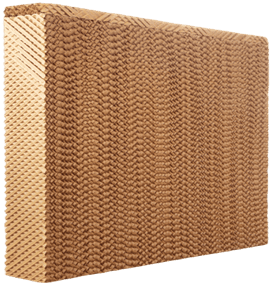
The Energy Company cellulose pad, produced by Koulansell, consists of regular, corrugated thin sheets made of kraft paper with high wettability and water absorption properties, treated with chemical materials to enhance strength and durability. The uniform and dense structure of the cellulose pad increases the contact surface between air and water and ensures more uniform airflow compared to wood wool.
Cellulose pads were designed and produced in the early 1980s with a honeycomb, uniform, and stable structure to address the issues of wood wool mentioned earlier. Their advantages are listed below. (Figure 1)
|
 |
Characteristics of Cellulose Pad
Unlike wood wool, the uniform and stable structure of the cellulose pad ensures even water distribution across its entire surface. Its strong structure prevents deformation and sagging, maintaining consistent cooler performance throughout the season. The material and geometric structure of the cellulose pad increase water absorption and the contact surface between air and the wet surface, resulting in higher evaporation efficiency. (Figure 2)

(Figure 2)
Comparison of Cooling Performance: Cellulose Pad vs. Wood Wool
The performance comparison between cellulose pad evaporative coolers and wood wool evaporative coolers was conducted in Tehran under climatic conditions based on the (ASHRAE 2021) standard. These results were obtained over different time intervals during the summer season under identical conditions after installation.
A) Outlet Air Temperature Calculation (Initial Operation)
In this condition, based on the calculations, the cooling difference between wood wool and cellulose pad evaporative coolers at initial operation is 3.2%.
Psychrometric process of initial operation of evaporative coolers (wood wool and cellulose pad)
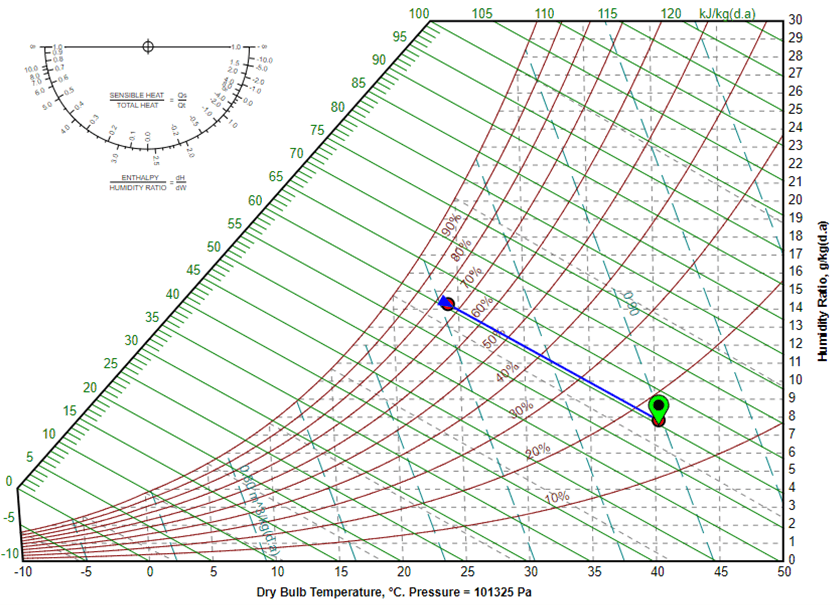
Psychrometric process of initial operation of evaporative coolers (wood wool and cellulose pad)
B) Outlet Air Temperature Calculation (After 3 Weeks of Operation)
According to the World Bank report (1999), evaporative coolers with cellulose pads do not experience any reduction in evaporation efficiency even after one season of operation. In contrast, wood wool coolers show about a 50% decrease in efficiency after only three weeks of operation; however, in this report, a 20% reduction is considered for calculations.
In this case, based on the calculations, the cooling difference between wood wool and cellulose pad evaporative coolers after approximately three weeks of operation reaches 37%.

Psychrometric process of wood wool cooler after three weeks of operation
Therefore, it can be concluded that Energy’s cellulose evaporative coolers maintain consistent performance throughout the season due to the quality of the cellulose pads used, whereas the cooling efficiency of wood wool coolers decreases over time.
Cellulose pad produced by Koulansell is the only cellulose pad approved by Energy.
References:
Corporation MUNTERS
World Bank Technical Paper No. 421